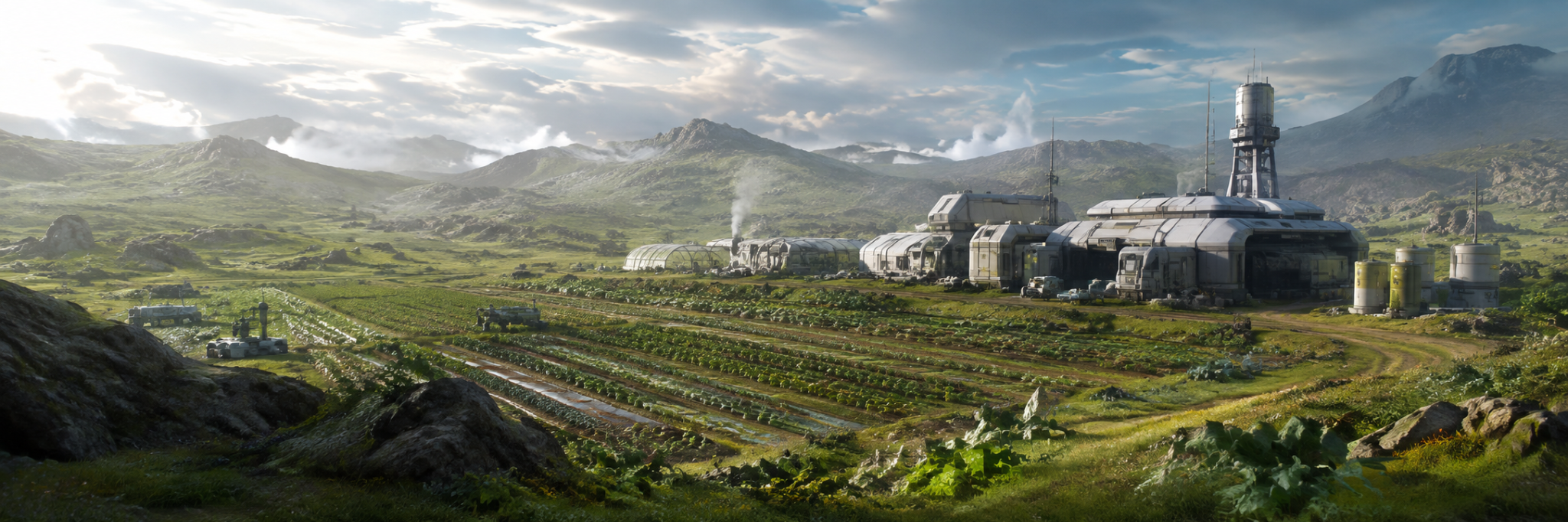
PLANETARY FARMING IN STAR CITIZEN
Low-Tech Farming, High-Tech Hydroponics and the Agricultural Base Economy
Agriculture in Star Citizen is no longer confined to the MISC Endeavor.
Cloud Imperium Games has repeatedly described farming as part of the future planetary settlement economy, beginning with early outpost concepts and developing into the more sophisticated base-building system presented at CitizenCon 2954.
The modern design divides planetary agriculture into two broad approaches:
- Low-tech farming
- High-tech farming
At first glance the distinction appears simple.
Low-tech farming uses the natural planetary environment.
High-tech farming uses purpose-built controlled facilities.
But underneath that distinction sits a much larger system involving seeds, soil, nutrients, environmental suitability, water availability, temperature, specialised plant strains, harvesting, storage and potentially the wider crafting economy.
This article reconstructs what CIG has actually said about that system.
Where CIG has not provided an answer, the question remains open.
1. FARMING HAS BEEN PART OF BASE BUILDING FOR YEARS
Planetary agriculture did not begin with CitizenCon 2954.
In CIG's 2017 design for player land claims and outposts, hydroponics was already included as one of the available settlement modules.
CIG described the hydroponics module as a facility that:
“fosters the growth of various types of organic materials for periodic harvesting.”
The same outpost design included storage modules capable of holding the resulting organic products.
This is an important early definition.
Planetary farming was not described simply as scenery or a way of producing generic food.
It was intended to create physical organic resources that could be harvested and stored.
2. FROM PREFAB OUTPOSTS TO PLAYER-BUILT SETTLEMENTS
By 2020, CIG's base-building plans had expanded significantly.
Rather than simply placing a completed prefabricated outpost, players were now intended to construct individual structures and connect them into larger settlements.
CIG specifically mentioned:
- power generators;
- turrets;
- resource collectors; and
- hydroponic domes.
as examples of the structures such settlements could contain.
This represented an important change in philosophy.
Agriculture was becoming one component inside a larger industrial settlement rather than an isolated building.
A farm could therefore exist alongside power production, extraction, refining, storage, habitation and defensive infrastructure.
That broader relationship became much more explicit at CitizenCon 2954.
3. CITIZENCON 2954: FARMING BECOMES A DEFINED PROFESSION
During the Crafting Your Home presentation at CitizenCon 2954, CIG presented farming as one of the industrial functions available to player-built bases.
Most importantly, CIG divided farming into two distinct forms:
- Low-tech farming
- High-tech farming
That distinction provides the clearest current framework for planetary agriculture.
Low-tech farming depends primarily upon the existing planetary environment.
High-tech farming instead requires specialised infrastructure.
The two approaches therefore appear to solve the same agricultural problem differently.
4. LOW-TECH FARMING
CIG described low-tech farming as the simpler agricultural approach.
The player begins by acquiring seeds.
Those seeds must then be planted somewhere suitable.
The environment matters.
The soil matters.
The crop requires nutrients.
Eventually the mature plant can be harvested.
The basic confirmed sequence is therefore:
Acquire seeds
→ find a suitable environment
→ use appropriate soil
→ provide nutrients
→ allow the crop to grow
→ harvest
This is a genuine agricultural loop rather than a generic production timer.
The planet itself is part of the production system.
5. LOCATION IS AN AGRICULTURAL RESOURCE
Low-tech farming introduces an important restriction.
Not every crop can simply be planted everywhere.
CIG's newer planetary technology allows different locations to possess different environmental characteristics.
These conditions affect what vegetation can survive there.
That means choosing where to establish a farm may be just as important as choosing what to grow.
A location suitable for one crop may be unsuitable for another.
Planetary farming therefore begins before the seed enters the ground.
It begins with site selection.
6. THE GENESIS ENVIRONMENTAL SYSTEM
CIG's Genesis planetary technology provides much of the underlying environmental context for modern farming.
Genesis allows planetary regions to contain systemic environmental data rather than merely visual terrain differences.
CIG has demonstrated environmental variables including:
- temperature;
- soil type;
- soil depth;
- soil quality;
- nutrient availability; and
- water availability.
Vegetation types can then be assigned rules determining the conditions in which they can survive and flourish.
CIG describes these results in terms of plant viability and vitality.
This is highly important for agriculture.
A planetary environment can now theoretically be evaluated according to whether it is actually suitable for a particular plant rather than merely whether there is enough empty terrain to place a farm.
7. SOIL IS NOT JUST GROUND TEXTURE
The modern planetary system treats soil as a collection of properties rather than a single universal material.
CIG has demonstrated distinctions including:
- soil type;
- soil depth;
- soil quality; and
- nutrient content.
Low-tech farming specifically references the importance of selecting the correct environment and soil for a crop.
This potentially makes soil one of the most important constraints on planetary agriculture.
Two visually similar areas may not necessarily offer identical agricultural value.
CIG has not yet shown the complete player-facing system for analysing or modifying these properties.
But soil suitability is clearly part of the modern farming design.
8. CIG HAS PREVIOUSLY DISCUSSED MODIFYING SOIL
The idea of changing agricultural conditions is not entirely new.
In the 2017 follow-up Q&A on land claims, CIG stated that players might eventually be able to subtly alter the composition of surface soil to improve farming.
CIG also discussed the longer-term possibility of limited localized atmospheric modification.
These statements were exploratory, not confirmed current mechanics.
They nevertheless establish an important design intention:
CIG has considered farming as something in which players may alter environmental conditions to improve agricultural productivity.
This idea becomes especially relevant when comparing low-tech and high-tech farming.
9. NUTRIENTS
The modern farming presentation explicitly states that crops require nutrients.
Genesis also models nutrient content as a characteristic of soil.
This creates two potential sources of plant nutrition:
naturally available nutrients within the environment,
and nutrients supplied by the farmer.
CIG has not yet demonstrated the complete interaction system for fertilisation.
CIG has not established whether players will apply physical fertilizer commodities, adjust nutrient mixtures through an interface, replenish soil chemistry or use another mechanism.
What is confirmed is simpler:
plant nutrition matters.
10. WATER
Water availability is also part of CIG's environmental simulation.
Genesis can use available water as one of the conditions affecting vegetation.
This makes water another potential limitation on where low-tech crops can thrive.
However, CIG has not yet demonstrated the full player-facing irrigation system for planetary farming.
The documented distinction is between:
water availability affects vegetation
and
players manually irrigate farms.
The first is supported by CIG's environmental design.
The second has not yet been sufficiently demonstrated.
11. TEMPERATURE
Temperature is one of the clearest environmental restrictions.
CIG explicitly explained during its planetary demonstrations that not every plant can survive at every temperature.
A farm therefore cannot necessarily grow the same crops everywhere.
A cold world, temperate world and hot world may offer fundamentally different agricultural opportunities.
For low-tech farming, this means the farmer adapts the crop to the environment.
That distinction becomes crucial when considering high-tech farming.
12. PLANT VIABILITY
Modern Star Citizen vegetation is increasingly systemic.
Instead of placing every species arbitrarily, environmental conditions can determine whether a plant should naturally occur in a location and how well it thrives there.
This produces an agricultural principle:
Plant + Environment = Viability
A successful low-tech farmer therefore needs to understand both sides of that equation.
The correct seed in the wrong environment may be worthless.
The correct environment paired with the correct crop becomes productive land.
13. SEEDS
Seeds are explicitly part of modern farming.
CIG's CitizenCon demonstration begins the low-tech farming loop with obtaining seeds.
This is significant because it makes the crop itself something the player selects and acquires rather than a property permanently attached to a farm building.
The final seed economy remains largely undefined.
CIG has not yet established:
- how seeds are obtained;
- whether plants produce new seeds;
- whether seed quality exists;
- whether seeds expire;
- whether rare seeds must be discovered; or
- whether strains can be traded independently.
These remain open questions.
14. HIGH-TECH FARMING
High-tech farming uses another approach.
Rather than relying entirely upon naturally suitable terrain, the player constructs specialised hydroponic buildings.
CIG described these facilities as more involved to establish than low-tech farms.
In return, high-tech farming provides access to exclusive strains of plants.
That is currently the clearest confirmed advantage CIG has attached to high-tech agriculture.
This is important.
High-tech farming is not merely presented as low-tech farming inside a prettier building.
It grants access to agricultural products that cannot apparently be obtained through the simpler method.
15. HYDROPONICS
Hydroponic agriculture has appeared repeatedly in CIG's settlement designs.
In 2017, hydroponic outpost modules were described as producing harvestable organic materials.
In 2020, CIG again listed hydroponic domes as player-buildable settlement infrastructure.
And in 2954, hydroponic buildings became the defining infrastructure of high-tech farming.
This gives hydroponics unusually strong continuity across several generations of CIG base-building design.
The exact mechanics have evolved.
The underlying role has not disappeared.
16. WHAT MAKES HIGH-TECH FARMING DIFFERENT?
CIG has provided one explicit advantage:
exclusive plant strains.
That immediately creates a potential economic distinction.
Low-tech farming uses crops suited to naturally available conditions.
High-tech farming gives players access to plant varieties associated with specialised controlled infrastructure.
What CIG has not yet established is exactly why those strains are exclusive.
CIG has not established whether they require:
- controlled temperature;
- special nutrients;
- artificial lighting;
- special atmospheric composition;
- hydroponic growth media;
- genetic modification; or
- some combination of those systems.
Until CIG provides further detail, the answer remains unresolved.
17. LOW-TECH VERSUS HIGH-TECH
Low-tech and high-tech farming address the same agricultural objective through different relationships with the environment.
Figure 03 compares the documented elements of each approach. Low-tech farming depends upon finding planetary conditions suitable for a chosen crop. High-tech farming requires specialised hydroponic infrastructure and provides access to exclusive plant strains.
The extent to which high-tech facilities can overcome environmental restrictions remains unknown. CIG has not established that a hydroponic building allows every plant to grow on every planet.
18. NATURAL ENVIRONMENT VERSUS CONTROLLED ENVIRONMENT
This may eventually become the defining strategic choice between the two farming systems.
Low-tech farming asks:
Where can this plant grow?
High-tech farming may increasingly ask:
What environment can I create for this plant?
The first relies upon planetary suitability.
The second uses technology to reduce dependence upon the naturally available environment.
CIG has clearly established the first principle.
The second is strongly suggested by hydroponic high-tech farming but its exact environmental controls remain undocumented.
For now, this distinction should therefore be presented as analysis rather than confirmed implementation.
19. AGRICULTURE IS PART OF THE BASE ECONOMY
A farm does not exist in isolation.
CitizenCon 2954 presented player settlements containing a range of industrial functions including:
- resource extraction;
- refining;
- power generation;
- storage;
- fabrication;
- agriculture; and
- other infrastructure.
This means farming should be understood as one profession within a larger player-built economic network.
Crops or organic materials may need to be stored.
They may be traded.
Some may eventually be processed.
Some may become inputs to crafting or other industrial systems.
But CIG has not yet mapped the complete agricultural production chain.
20. ORGANIC MATERIALS
The older outpost documentation uses particularly interesting terminology.
Hydroponics modules produce organic materials.
Storage modules can then hold organic products.
This implies that farming outputs are not necessarily limited to ready-to-eat food.
Agriculture can potentially create resources that participate in other economic processes.
Modern CIG commodity documentation reinforces the broader concept by describing commodities as goods intended primarily for processing or trade and listing hydroponic farms among their sources.
This does not tell us exactly which future crops become commodities.
But it establishes agriculture as part of the physical resource economy.
21. WHAT HAPPENS AFTER HARVEST?
This remains one of the largest unanswered questions.
The confirmed farming loop reaches:
Seed → environment → growth → harvest
But CIG has not yet fully documented what happens afterward.
Possible categories clearly exist elsewhere in Star Citizen:
- food;
- organic commodities;
- biological materials; and
- potentially crafting inputs.
The machinery connecting them has not yet been established.
CIG has not established whether farms produce finished commodities directly.
CIG has not established whether harvested crops require processing.
CIG has not established which industrial facilities process biological materials.
CIG has not established whether crop quality affects later products.
Those stages should remain visibly unresolved in IFA diagrams.
22. FARMING AND STORAGE
Storage has accompanied agriculture since the early outpost design.
The 2017 land-claim documentation specifically pairs hydroponics with storage capacity for organic products.
This matters because agricultural output is physical material.
A large farm potentially requires:
- production space;
- storage capacity;
- transport; and
- eventually market access.
When base building becomes operational, agricultural infrastructure may therefore need to be designed as part of a logistics system rather than merely as isolated crop plots.
The exact storage volumes and handling mechanics are not yet known.
23. FARMING AND POWER
High-tech agriculture is part of a base-building system in which structures depend upon infrastructure such as power generation.
CIG has shown multiple power-generation concepts for settlements.
However, CIG has not yet publicly provided enough information to quantify the electrical requirements of hydroponic agriculture.
Power consumption figures and a defined energy model for high-tech farming remain undocumented.
What can safely be said is that hydroponic facilities exist within an infrastructure system in which power generation is a fundamental base function.
24. FARMING AND CRAFTING
CitizenCon 2954 presented base building and crafting as closely connected parts of the future economy.
Resources are gathered.
Materials are processed.
Blueprints define manufactured products.
Player bases provide facilities for carrying out those processes.
Agriculture exists inside that same industrial ecosystem.
This makes it reasonable to expect some agricultural outputs to eventually participate in crafting or processing.
But CIG has not yet explicitly defined the agricultural recipes or production chains involved.
Until that happens, agriculture-to-crafting connections remain potential rather than confirmed.
25. RESOURCE QUALITY
Modern Star Citizen now contains an implemented quality system for mined crafting resources.
Resources can possess different quality values.
Those values can survive refining.
Blueprints can impose quality requirements.
Higher-quality inputs can affect the resulting manufactured product.
This raises an obvious agricultural question:
Can crops also possess quality?
The old Endeavor design strongly suggests that agricultural quality matters within CIG's broader farming philosophy.
But modern planetary farming has not yet demonstrated agricultural quality as part of the current crafting-quality implementation.
This remains an important unresolved connection.
26. LAND ITSELF MAY HAVE ECONOMIC VALUE
If different soil, temperatures, water availability and other environmental variables affect plant viability, agricultural land is not necessarily interchangeable.
A particular location may be valuable because its conditions support a desirable crop.
Another location might have poor agricultural value despite being useful for mining, manufacturing or habitation.
This creates the possibility that base location will represent a genuine industrial decision.
That conclusion follows logically from CIG's environmental and farming systems.
The final player economy around agricultural land has not yet been demonstrated.
27. FARM DESIGN MAY BECOME A SYSTEMS PROBLEM
The eventual planetary farmer may therefore need to think beyond the individual plant.
A successful agricultural base could involve:
- site selection;
- crop selection;
- power;
- water;
- storage;
- transport;
- environmental suitability;
- industrial infrastructure; and
- market access.
Some of these interactions are confirmed.
Others are still emerging.
The important point is that CIG is building farming inside a broader settlement economy rather than treating it as a completely isolated minigame.
28. WHAT WE CURRENTLY KNOW ABOUT LOW-TECH FARMING
CONFIRMED MODERN DESIGN
- Seeds are required.
- Environmental suitability matters.
- Soil matters.
- Nutrients matter.
- Plants grow and are harvested.
- Plant viability is affected by environmental conditions.
- Temperature can restrict plant suitability.
- Modern planetary technology models soil, nutrients and water availability.
WHAT REMAINS UNKNOWN
- exact irrigation mechanics;
- exact fertilization mechanics;
- crop growth times;
- crop quality;
- crop diseases;
- yield calculations;
- seed reproduction;
- crop rotation;
- mechanisation; and
- detailed harvesting interactions.
29. WHAT WE CURRENTLY KNOW ABOUT HIGH-TECH FARMING
CONFIRMED MODERN DESIGN
- High-tech farming requires specialised hydroponic buildings.
- It is more involved to establish than low-tech farming.
- It grants access to exclusive plant strains.
- Hydroponics has repeatedly appeared in CIG's base-building plans.
WHAT REMAINS UNKNOWN
- which environmental variables the facility controls;
- whether soil is completely eliminated;
- whether water/nutrient mixtures are manually managed;
- whether artificial lighting matters;
- whether atmosphere is controlled;
- whether crops grow faster;
- whether yields are higher;
- whether quality is superior; and
- exactly which strains require high-tech production.
These are questions.
They remain unresolved questions, not established features.
30. THE CURRENT IFA ASSESSMENT
Based upon CIG's published material, planetary farming is best understood as an environment-dependent resource profession embedded within the player-base economy.
Low-tech farming relies heavily upon the naturally available environment.
Crop selection, location and soil suitability therefore become fundamental decisions.
High-tech farming introduces specialised hydroponic infrastructure and access to exclusive plant strains.
The deeper mechanics of those controlled facilities remain largely undocumented.
The most important modern development is that Star Citizen's planetary technology increasingly models the environmental properties agriculture requires.
Soil is systemic.
Temperature is systemic.
Water availability is systemic.
Nutrients are systemic.
Plant suitability is systemic.
This creates the foundation for farming to become considerably more than placing a crop plot and waiting for a production timer.
The planet itself is part of the agricultural machine.
And high-tech farming may ultimately be the player's means of gaining greater control over that machine.
Exactly how far that control extends remains one of the biggest unanswered questions in Star Citizen agriculture.