Planetary agriculture eventually reaches a point where production is no longer the limiting factor. Transport is.
At sufficient scale, conventional orbital freight introduces an unavoidable interruption into agricultural logistics. Cargo must be assembled into discrete loads, transferred to vehicles, carried into orbit, unloaded and followed by another transport cycle.
IFA Science & Technology developed HARVESTLINE™ to remove that interruption. The system connects a planetary agricultural terminal directly with orbital storage, trading the speed of an individual shipment for the uninterrupted movement of agricultural mass.
The orbital architecture is developed under contract with Crusader Industries, while Argo Astronautics supplies the carrier interfaces and industrial handling equipment at both terminals. At the upper station, HARVESTLINE™ meets the same MISC Hull-series freight network used by Project Titan.
CONTINUOUS ORBITAL TRANSFER
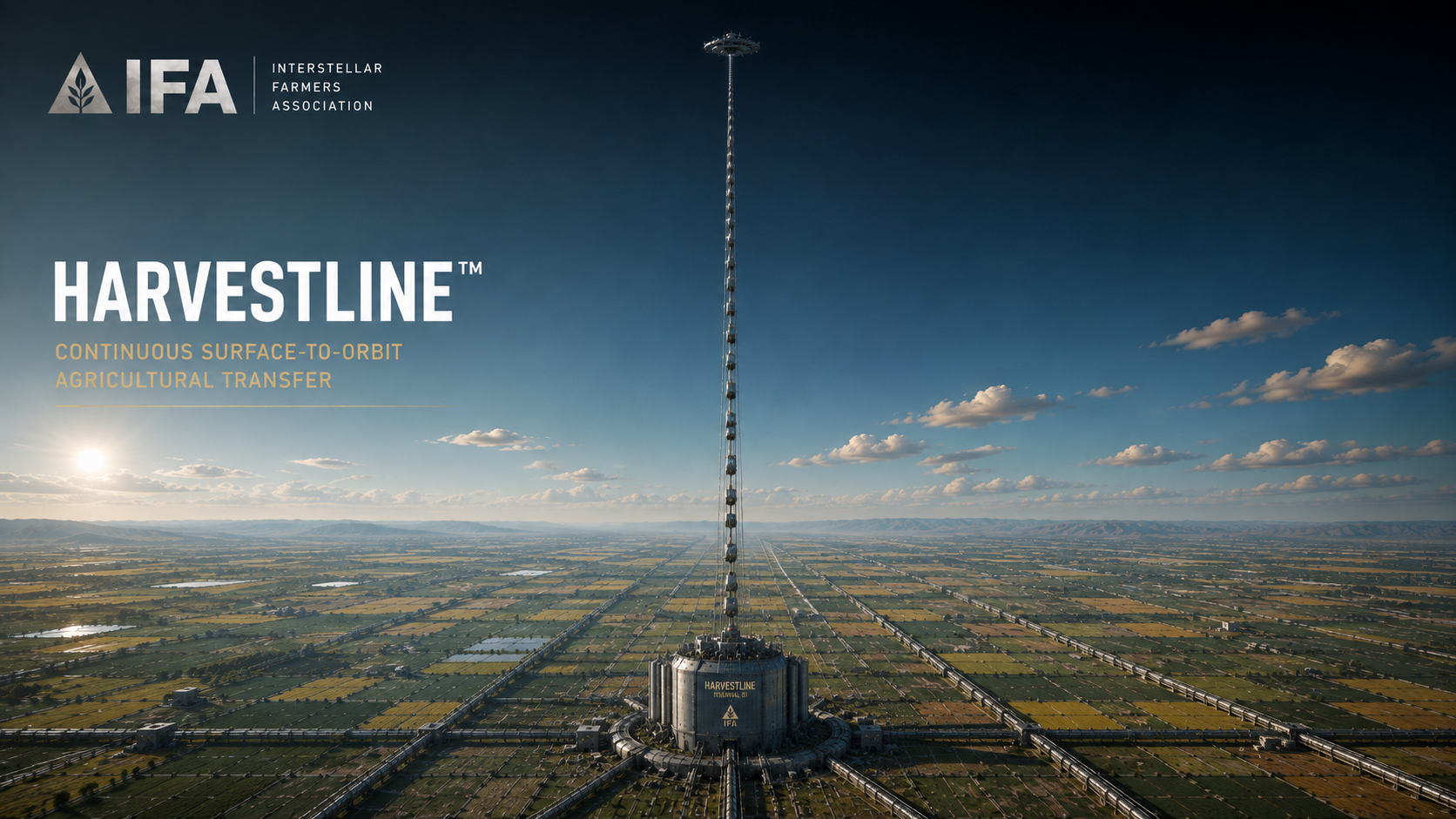
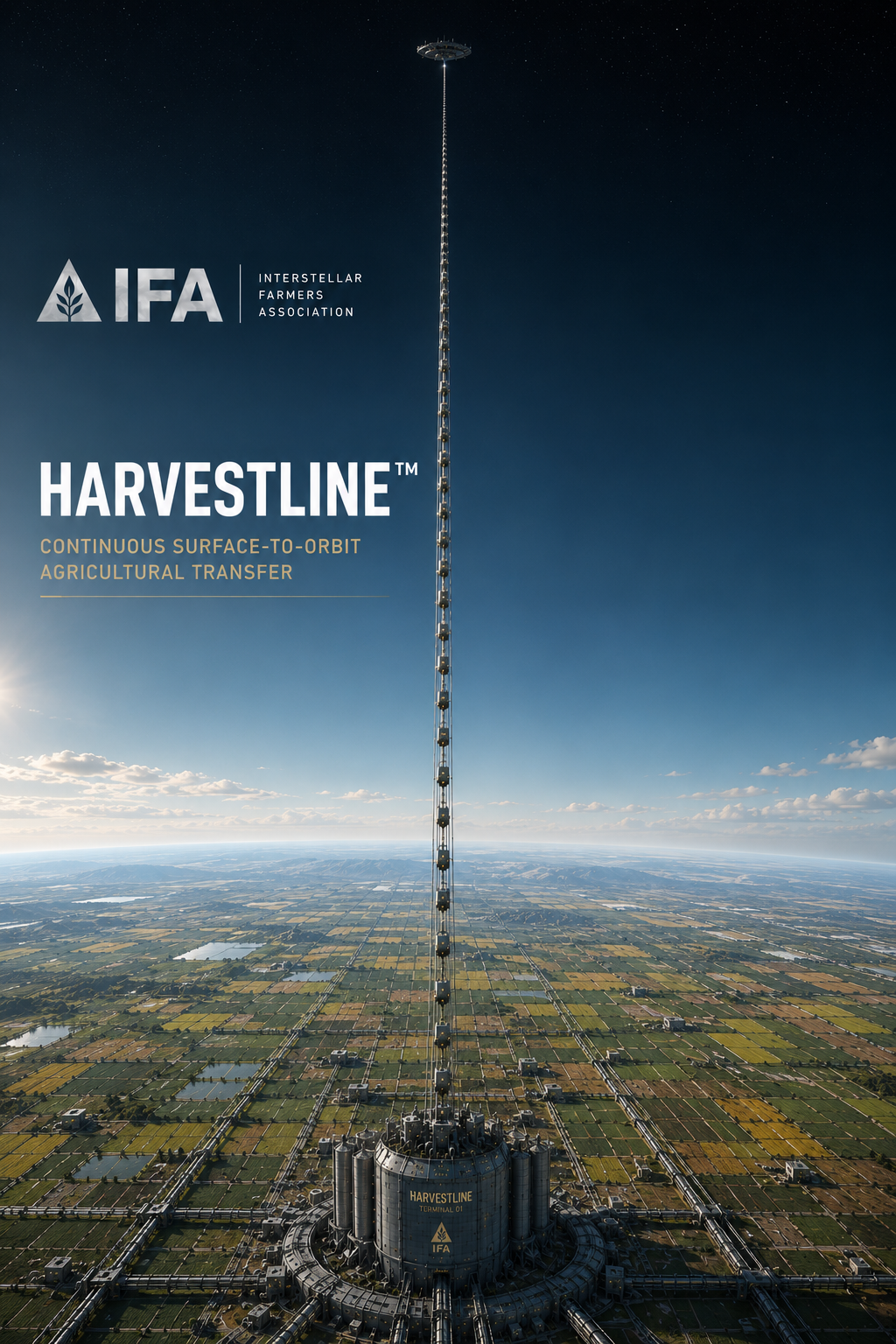
HARVESTLINE™ operates through a permanent surface-to-orbit tether infrastructure carrying a continuous sequence of dedicated agricultural carriers.
Harvested material enters the system through a planetary silo terminal.
The material is stored, metered into carriers and introduced onto the transfer line at controlled intervals.
Multiple carriers occupy the system simultaneously.
While one carrier approaches orbital storage, others are already in ascent behind it.
Once steady-state operation is established, the arrival of agricultural material in orbit is determined by carrier spacing rather than the full transit time of an individual load.
The operating principle is therefore different from a conventional elevator cycle: HARVESTLINE™ behaves as a flow system.
THE PLANETARY TERMINAL
The lower terminal functions as the interface between planetary agriculture and orbital infrastructure. Harvest arriving from regional production areas is received into large buffer silos before being introduced into HARVESTLINE™. This storage capacity separates agricultural activity from the immediate operating state of the transfer line. Harvesting does not need to stop because a carrier is unavailable. Likewise, HARVESTLINE™ does not need to wait for a particular farm or harvesting operation to deliver its next load. The terminal continuously converts irregular agricultural deliveries into a controlled material stream. Its primary functions are:
- Reception
- Temporary storage
- Material handling
- Load metering
- Carrier loading
- Dispatch
The result is a stable feed into the orbital transport system.
THE CARRIER STREAM
HARVESTLINE™ is designed around a large number of standardized cargo carriers rather than a small number of large elevator vehicles.
Each carrier handles a fraction of the total agricultural flow.
Together they create a continuous sequence of ascending cargo.
The individual carrier is deliberately simple, existing primarily to contain agricultural material, interface with the tether and complete the ascent reliably.
It does not require the systems associated with crewed transport or general-purpose spacecraft.
This reduction in complexity allows HARVESTLINE™ to treat the carrier as part of the infrastructure rather than as an independent vehicle.
The importance of any one carrier is therefore limited.
The capacity of the system lies in the stream.
THROUGHPUT OVER TRANSIT TIME
HARVESTLINE™ was designed around a basic agricultural logistics principle:
Bulk production is governed by throughput, not by the travel time of an individual unit.
A crop carrier may require a comparatively long period to travel from the surface to orbital storage. That does not prevent the system from achieving very high sustained capacity. Once the transfer line is populated, carriers arrive continuously. The relevant measure is therefore not:
INDIVIDUAL TRANSIT
How long does one carrier require to reach orbital storage?
SYSTEM THROUGHPUT
How much agricultural mass crosses into orbit during continuous operation?
For high-volume agricultural exports, that distinction is decisive.
ORBITAL STORAGE
At the upper end of HARVESTLINE™, agricultural material is discharged into a dedicated orbital silo terminal. The orbital terminal performs the same buffering function as the planetary installation. Incoming material is accumulated independently of spacecraft arrival schedules. Interplanetary freight vessels can therefore remain in orbit and load directly from stored agricultural inventory. They do not need to descend to the producing world. They do not need to wait for a harvest operation. They do not need to coordinate their arrival with individual surface shipments. HARVESTLINE™ continuously replenishes orbital inventory. Space freight begins only after the crop has already left the planet.
TWO INDEPENDENT LOGISTICS SYSTEMS
The use of buffer storage at both ends of HARVESTLINE™ separates planetary agriculture from interplanetary freight.
Below the transfer line, farms supply the planetary terminal. Above it, spacecraft draw from orbital storage. Between them, HARVESTLINE™ maintains the material flow.
This removes the requirement for all three systems to operate on the same schedule.
A temporary reduction in spacecraft demand increases orbital inventory.
A temporary interruption to the transfer line increases planetary inventory.
Agricultural production can continue until available storage capacity is exhausted.
The silos therefore function as part of the transport architecture rather than simply as storage buildings.
AGRICULTURAL CARGO
HARVESTLINE™ is optimized for agricultural commodities whose economic value depends primarily upon reliable bulk movement.
Stable crops and processed agricultural materials are particularly suitable.
More sensitive products can require specialized handling.
Temperature-controlled cargo, biologically active materials and highly perishable produce impose requirements that are not removed simply because transport is continuous.
HARVESTLINE™ therefore does not attempt to force every agricultural commodity into a single transport standard.
Its principal advantage is achieved where volume is high and continuous movement is more important than individual delivery speed.
RETURN TRAFFIC
The carrier cycle does not end in orbit. After discharge, carriers must return to the planetary terminal and re-enter service. HARVESTLINE™ therefore maintains both ascending cargo traffic and descending return traffic as parts of the same transport system. Loaded ascent and empty return are coordinated to prevent unnecessary interruptions to the primary agricultural flow. Where practical, descending carrier movement can also contribute to energy recovery within the system. The purpose is not merely to move material upward, but to maintain a continuous closed transport cycle.
SYSTEM CONTROL
Continuous operation requires centralized traffic management. Carrier spacing, tether loading, terminal inventory and available system capacity are monitored as one integrated process. Additional agricultural mass is admitted only when sufficient capacity exists within the line. A fault affecting one carrier therefore does not result in uncontrolled accumulation behind it. Traffic can be slowed or stopped while incoming agricultural material is redirected into planetary buffer storage. The system is designed around two equally important conditions:
CONTINUOUS OPERATION
Maintain carrier spacing and sustained agricultural throughput while the line remains within its operating capacity.
CONTROLLED INTERRUPTION
Slow or stop carrier traffic safely while incoming material is absorbed by planetary buffer storage.
High throughput is only useful when the infrastructure can recover from failure without destabilizing the entire logistics chain.
THE AGRICULTURAL ORBITAL TERMINAL
The orbital terminal is more than the upper end of the tether. It forms the transition between planetary agriculture and the wider interplanetary economy. Agricultural material arriving from the surface is consolidated into large orbital reserves. Multiple production regions can therefore feed a common export point. Freighters arriving from elsewhere in the system access a prepared stockpile rather than individual planetary producers. At sufficient scale, the terminal becomes an orbital agricultural distribution center. The producing world effectively extends its agricultural infrastructure beyond the atmosphere.
FROM AGRIFORMING TO EXPORT
HARVESTLINE™ was developed in response to the increasing scale of IFA planetary agriculture.
Agriform™ makes previously unsuitable environments capable of supporting agricultural production.
Once those worlds mature into major agricultural producers, the logistical requirement changes.
The problem is no longer establishing viable farmland.
It is moving the resulting agricultural mass beyond the planet efficiently enough to prevent transport capacity from limiting production.
HARVESTLINE™ addresses that stage directly.
It is the connection between planetary agricultural output and orbital commerce.
SCIENCE & TECHNOLOGY
HARVESTLINE™ was developed by IFA Science & Technology through the integration of contracted orbital engineering with established bulk agricultural handling principles.
The project approached orbital freight as an industrial flow problem.
Conventional systems move cargo in journeys.
HARVESTLINE™ moves material through infrastructure.
This distinction allowed the surface-to-orbit transport stage to be treated in the same way as other continuous agricultural systems: receive material, regulate flow, maintain capacity and buffer variations in demand.
The result is a permanent agricultural export route rather than a sequence of launches.
A DIFFERENT MEASURE OF SPEED
HARVESTLINE™ does not attempt to outperform spacecraft in point-to-point transit time, because that is not the relevant comparison.
For bulk agriculture, the useful measure of speed is the rate at which material leaves the producing world.
A slower carrier operating inside an uninterrupted transport stream can move more total material than a faster system repeatedly interrupted by loading, ascent, unloading and return.
HARVESTLINE™ therefore defines performance through continuous capacity.
The system is successful when agricultural production no longer waits for orbital transport.
HARVESTLINE™
Planetary agriculture becomes industrial when the movement of its output must be engineered with the same seriousness as its production.
HARVESTLINE™ removes the gap between harvest and orbit.
Agricultural material enters at the planetary terminal and leaves as orbital inventory. Everything between those points remains in motion, so the harvest no longer waits for a launch.