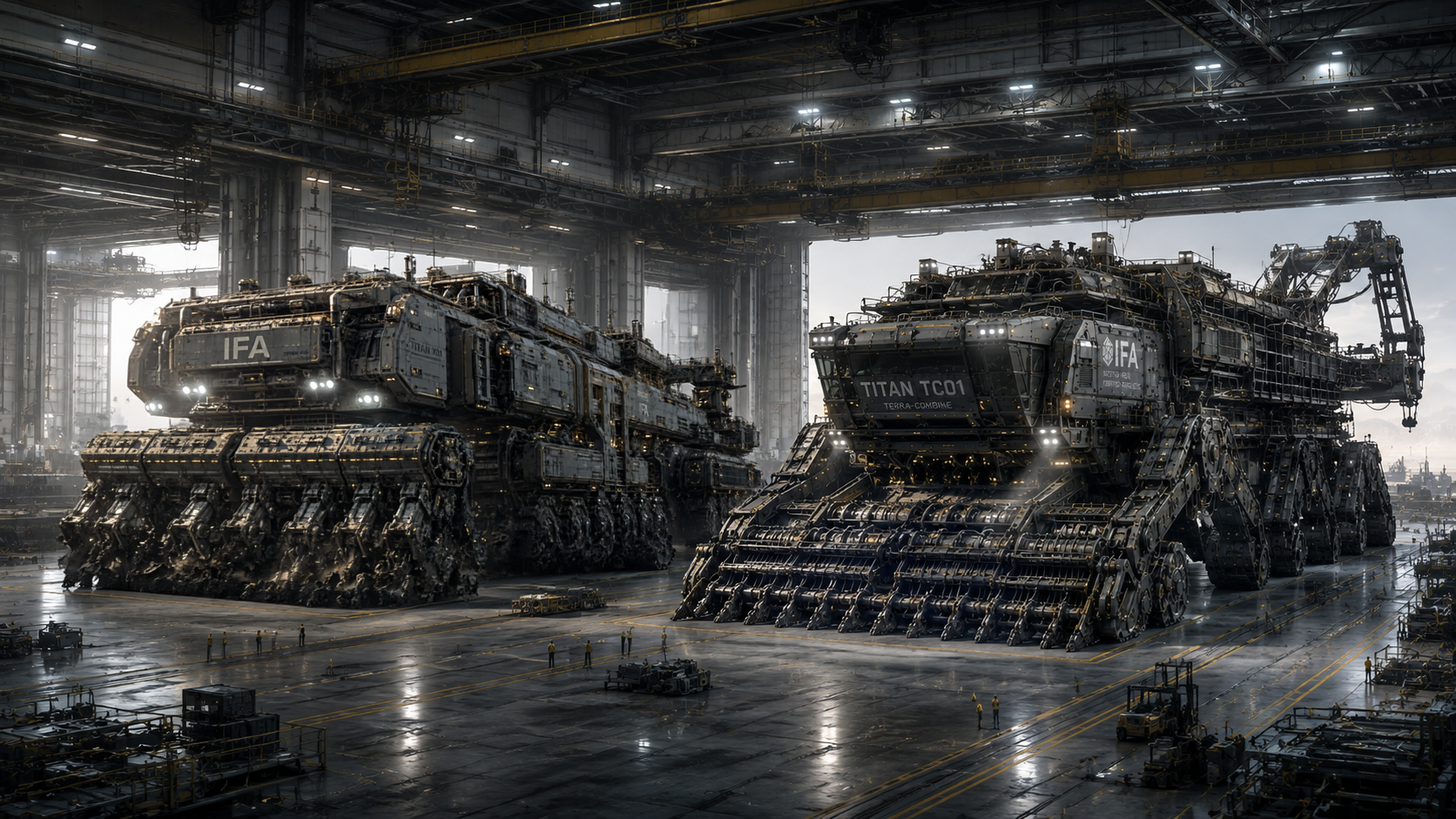
There comes a point where conventional agriculture stops being an answer. A new world cannot always be cultivated field by field, and vast territories cannot wait for generations of settlement and incremental expansion before becoming productive. When the objective is not simply to establish a farm but to bring a planetary region into sustained production, the machinery must change with the ambition.
The Titan Project is IFA’s answer: not a single vehicle, but a moving agricultural industry assembled from the finest heavy engineering the Empire can supply.
Developed as an open research programme, Project Titan explores agriculture at a scale previously reserved for planetary engineering and heavy industry. It is a complete mechanised cultivation system designed to move continuously across enormous areas of planetary terrain, transforming accessible land into productive agricultural territory and returning later to harvest it.
At the centre of Project Titan are two machines. The Titan X01 Terra-Planter advances first, creating fields rather than merely preparing them.
Moving across the surface, the X01 performs the successive operations normally divided between fleets of agricultural machines: breaking and working the ground, removing obstructive stone, cultivating, fertilising and finally planting genetically modified crops selected for the conditions of the target world.
Its operating environment is not defined by property boundaries, roads or existing agricultural infrastructure. The landscape itself defines the route.
The X01 is designed to continue forward across terrain that would stop conventional machinery entirely, altering course only where planetary geography makes passage impractical. Behind it stretches not a finished construction project, but something far more valuable: productive land.
Only after the X01 has disappeared beyond the horizon does the growing cycle begin. When the crop is ready, the Titan TC01 Terra-Combine follows the same agricultural corridor.
Travelling through the enormous cultivated corridors established by the X01, the TC01 performs the second half of Project Titan’s purpose. Crops and agricultural fungi are harvested and processed continuously as the machine advances, converting the biological output of the landscape into material ready for planetary export.
The machines themselves are assembled through a deliberately divided industrial programme. Crusader Industries supplies capital-scale structural and transport engineering, while Argo Astronautics develops the rugged handling systems and uncrewed cargo lifters that keep the harvest moving. In orbit, specially modified MISC Hull E superfreighters receive the output for distribution throughout the wider supply network.
The result is a continuous agricultural chain extending from soil to orbit.
BEYOND THE FARM
Project Titan changes the scale at which IFA approaches agricultural expansion. Traditional machinery is designed around the farm; Titan is designed around the geography of a planet.
Its extraordinary scale allows agricultural operations to begin where supporting infrastructure is limited or nonexistent. Instead of first constructing the logistical framework required to support enormous fleets of smaller machines, Project Titan concentrates the necessary capabilities into a purpose-built planetary agricultural system.
That requirement places both machines in an engineering category of their own.
The X01 and TC01 are effectively capital-class agricultural machines, built around power generation, cooling, protection and industrial systems normally associated with machinery of an entirely different order of magnitude.
Everything about Project Titan follows the same philosophy: if agriculture is to operate at planetary scale, the machinery must be planetary in ambition.
A MOVING AGRICULTURAL INDUSTRY
Project Titan is not intended to replace conventional agriculture. It exists for worlds where productive territory extends far beyond the reach of existing roads, workshops and settlements; where population growth is moving faster than agricultural development; and where a promising landscape must be connected to the interplanetary economy before conventional equipment could finish its first campaign.
Across that landscape the Titan X01 moves first, leaving life behind it. The Titan TC01 returns when the horizon is ready, and the harvest rises into orbit. What began as untouched terrain becomes another secured link in humanity’s food supply—one world at a time.