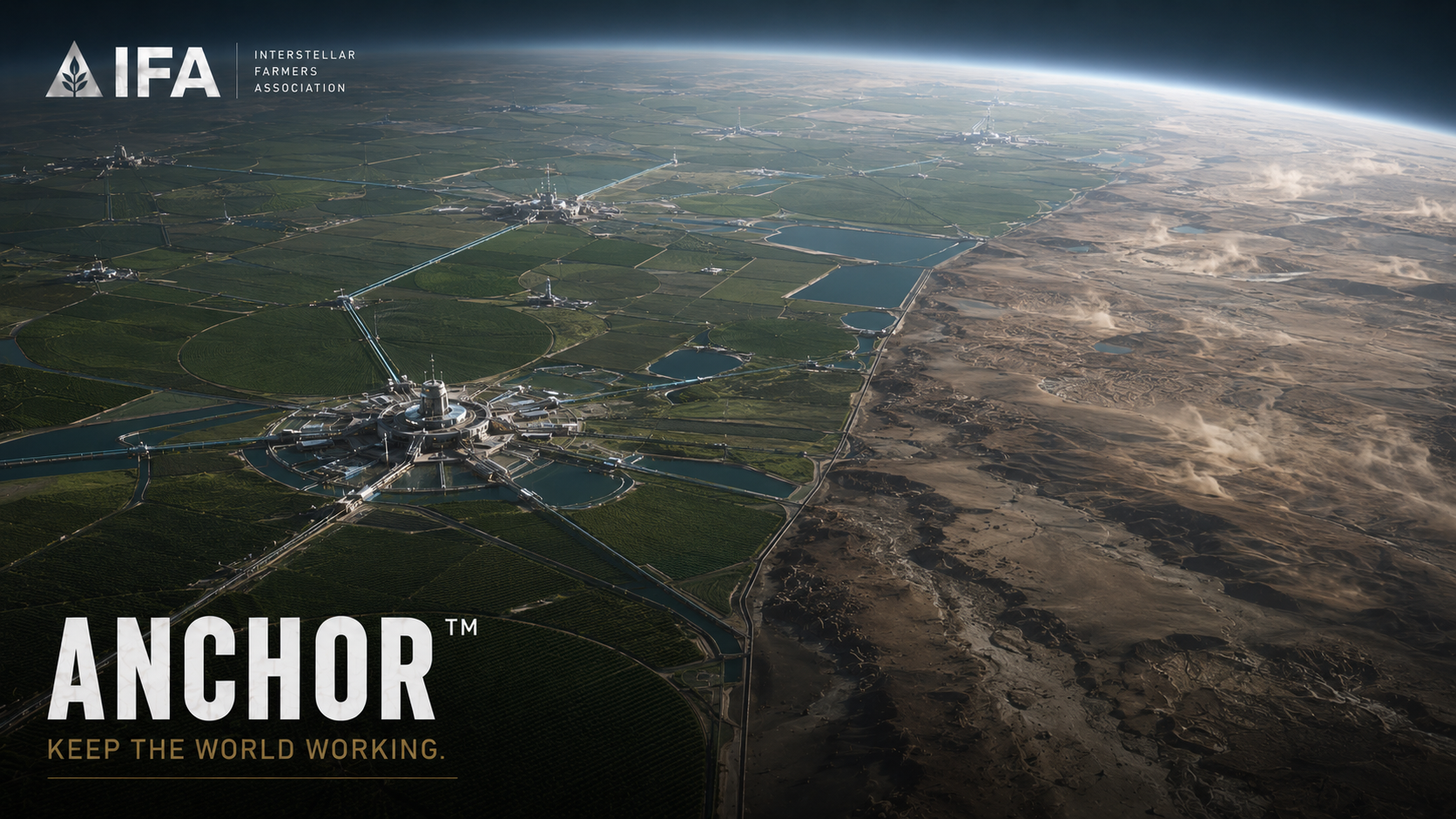
Maximum production leaves a physical record. Water tables fall, soils move, salts accumulate, exposed substrate produces dust, drainage patterns change and extraction alters the stability of the ground.
Regional cultivation changes surface reflectivity, moisture exchange and atmospheric loading.
At planetary agricultural scale, these effects cease to be local inconveniences.
Eventually they begin interfering with production itself.
ANCHOR™ was developed for that point.
ANCHOR is an integrated planetary monitoring and intervention programme designed to maintain heavily exploited agricultural environments within defined operational limits.
ANCHOR does not preserve a planet in its original state. It preserves the planet's ability to produce.
THE OPERATING ENVELOPE
Agricultural environments do not need to remain unchanged.
They need to remain usable.
ANCHOR begins by defining the physical conditions within which planetary production can continue.
Those limits vary between worlds and agricultural systems, but may include:
- Soil depth
- Groundwater level
- Surface stability
- Salinity
- Erosion rate
- Dust loading
- Drainage capacity
- Surface-water distribution
- Atmospheric particulate concentration
- Regional thermal conditions
IFA continuously compares those variables against production requirements.
Change itself is not the problem.
Change that crosses an operational threshold is.
ANCHOR exists to identify that threshold before production reaches it.
PLANETARY INSTRUMENTATION
A world under intensive cultivation cannot be managed from field samples alone.
ANCHOR therefore operates as a planetary observation system.
Its subsurface model incorporates licensed geological records from Shubin Interstellar, while remote field packages use hardened housings and utility platforms commissioned from Greycat Industrial. Neither company directs the agricultural programme. They provide the durable eyes with which IFA watches the world respond.
Orbital sensors monitor large-scale surface change.
Aerial platforms provide regional resolution.
Ground stations measure soil movement, moisture, salinity and atmospheric conditions.
Subsurface instruments track groundwater, geological movement and pressure changes.
Agricultural infrastructure contributes operational data of its own.
DEEPWELL reports extraction. Irrigation networks report distribution. Cultivation systems report soil conditions. Harvest systems report biomass production.
ANCHOR combines those measurements into a continuously updated model of the production environment.
The planet becomes an instrumented industrial asset.
DEPLETION HAS CONSEQUENCES
Removing a resource changes the system that contained it.
DEEPWELL can lower groundwater levels.
Large-scale mineral extraction can alter local geology and drainage.
Intensive cultivation removes nutrients and biological material.
Heavy agricultural infrastructure compacts and redistributes substrate.
Irrigation moves enormous quantities of water and dissolved minerals across the surface.
None of these processes occurs independently. ANCHOR models their interaction. A declining aquifer may increase pumping cost.
It may also contribute to ground compaction or subsidence under suitable geological conditions.
Irrigation may sustain crop production while progressively concentrating salts within poorly drained substrate.
Vegetation removal may simplify harvest operations while increasing exposure to wind erosion.
ANCHOR exists because optimizing each system individually can destabilize the system they share.
SUBSIDENCE CONTROL
Groundwater extraction does more than remove water.
In some geological formations, reducing pore pressure can compact water-bearing sediments and lower the land surface.
Where the geology permits compaction, subsidence can damage pipelines, alter drainage gradients, deform agricultural infrastructure and reduce the future storage capacity of the aquifer itself.
For DEEPWELL operations, this makes ground movement a production variable.
ANCHOR maps subsidence across extraction regions and compares it with infrastructure tolerances.
Where deformation threatens critical systems, pumping can be redistributed between extraction fields.
Infrastructure can be reinforced or realigned.
Drainage can be reconstructed.
Where economically justified, pressure-management measures can be introduced.
The objective is not to prevent the surface from moving.
It is to prevent movement from interrupting production.
SALT
Water moves minerals.
Evaporation frequently leaves them behind.
Under intensive irrigation, salts can accumulate in the root zone until agricultural productivity declines.
The problem becomes especially important where high evaporation, saline groundwater, poor drainage or repeated irrigation concentrate dissolved material faster than it can leave the cultivated substrate.
ANCHOR treats salinity as a mass-flow problem. Sensors identify accumulation. Hydrological models determine where salts are moving. Drainage systems remove saline water where necessary.
Selected fields can be flushed when the value of recovering productive substrate justifies the water expenditure.
Extracted salts and concentrated brines are diverted away from the active root zone.
The objective is not chemically pristine soil.
It is maintaining salinity below the tolerance of the production crop.
SOIL DOES NOT HAVE TO STAY PUT
Wind and water continuously redistribute exposed substrate. Industrial agriculture can accelerate that movement. Large uniform fields alter surface roughness. Harvest temporarily reduces vegetation cover. Drainage and irrigation alter runoff. Repeated cultivation changes soil structure.
On worlds with strong winds, fine material can leave productive regions entirely.
ANCHOR monitors where agricultural substrate is being lost, where it accumulates and whether that movement threatens future cultivation.
Intervention is targeted accordingly.
Wind-control structures can be deployed where they protect sufficiently valuable fields.
Surface geometry can be altered. Drainage can be redirected. Temporary cover can be established between production cycles.
Lost substrate can be mechanically replaced where replacement costs less than reconstruction.
IFA does not require every particle to remain where nature placed it.
It requires sufficient productive substrate to remain where the crop needs it.
DUST
A planetary agricultural operation creates exposed surfaces. Fields between crops. Excavation zones. Transport corridors. Dry reservoirs. Mineral-processing areas. Depleted regions.
Under suitable atmospheric conditions, these surfaces can become significant sources of airborne particulate matter.
At sufficient concentration, dust interferes with machinery, optical systems, solar infrastructure, atmospheric operations and plant performance.
ANCHOR therefore tracks dust generation and transport across production regions.
Intervention occurs where predicted particulate loading threatens economically important infrastructure or cultivation.
Surface binding. Targeted wetting. Temporary biological cover. Physical barriers. Operational changes. The method is secondary. The threshold is what matters.
Dust may move freely across thousands of square kilometres without consequence.
It becomes an ANCHOR problem when it begins costing IFA output.
WATER MUST LEAVE AS WELL AS ARRIVE
DEEPWELL solves the problem of getting water into agricultural territory.
ANCHOR deals with what happens afterward.
Continental irrigation without corresponding drainage can create entirely new hydrological conditions.
Groundwater can rise locally even while the source aquifer declines elsewhere.
Low areas can become waterlogged.
Dissolved minerals can accumulate.
Artificial runoff can concentrate in terrain never shaped to receive it.
ANCHOR models agricultural water after application as carefully as DEEPWELL models it before extraction.
Regional drainage networks are expanded or redirected according to production.
Water that remains useful can re-enter agricultural supply.
Water that becomes excessively saline or contaminated is separated from active cultivation.
The purpose is straightforward.
Water delivered to a crop must not become an obstacle to the next one.
SURFACE HYDROLOGY
At planetary scale, agriculture can reorganize landscapes. Reservoirs are created. Channels are cut. Fields are levelled. Water is transferred between catchments. Groundwater is extracted in one region and applied in another.
Natural drainage therefore becomes only one component of the operating hydrology.
ANCHOR maintains a continuously updated model of where water moves across the engineered landscape.
When existing drainage no longer serves agricultural requirements, it can be modified.
Channels can be enlarged. Flows can be diverted. Temporary storage can be constructed.
Low-value terrain can be designated to receive excess water where protecting productive regions has greater value.
The water system is not preserved because it is natural.
It is configured because agriculture requires one.
THERMAL DRIFT
Changing enormous areas of a planetary surface can alter how those areas interact with energy.
Dark vegetation, bare substrate, irrigated fields, dry soil and surface water absorb, reflect and redistribute heat differently.
Agriculture also changes evaporation and moisture exchange with the atmosphere.
ANCHOR therefore monitors regional thermal behaviour as cultivated territory expands.
Most changes require no intervention.
Some may even improve production.
Intervention begins only when temperature changes move important agricultural regions toward operational limits.
Crop genetics remain the first line of tolerance. Agricultural scheduling provides another. Water management provides another.
Agriform™ remains available when environmental change exceeds what local production systems can efficiently accommodate.
ANCHOR determines when that point is approaching.
PRODUCTION TRIAGE
Not every region deserves stabilisation.
This principle is fundamental to ANCHOR.
When an agricultural zone begins deteriorating, IFA compares the value of intervention against the remaining productive value of the region.
A high-output field above critical infrastructure may justify extensive stabilisation.
A declining peripheral region approaching the end of its planned extraction cycle may justify almost none.
ANCHOR therefore ranks intervention according to economic importance.
Some areas are protected. Some are modified. Some are harvested one final time.
Some are allowed to deteriorate while production migrates elsewhere.
Planetary stabilisation does not mean stabilising every part of the planet.
It means stabilising the parts that still matter.
CONTROLLED SACRIFICE
A planetary system can sometimes be stabilised more efficiently by allowing one region to absorb stress that would otherwise affect another.
ANCHOR incorporates this directly into planning.
Excess drainage may be routed toward territory with little remaining agricultural value.
Sediment may be allowed to accumulate outside active production zones.
Saline water can be concentrated away from future cultivation.
Infrastructure can be withdrawn from areas where subsidence mitigation no longer justifies its cost.
This creates deliberate gradients of investment across an agricultural world.
IFA does not distribute protection equally.
It concentrates protection where protection produces the greatest return.
The planet remains operational even if every part of it does not.
ANCHOR AND AGRIFORM
ANCHOR and Agriform™ address different stages of planetary engineering.
Agriform™ changes environmental conditions to establish or restore agricultural viability.
ANCHOR attempts to keep an existing production system inside its usable range.
That distinction matters. Minor deterioration does not justify planetary reconstruction. ANCHOR handles the intermediate condition. It corrects. Diverts. Reinforces. Drains. Redistributes. Contains. And measures.
Eventually, continued stabilisation may cost more than reconstruction.
At that point ANCHOR’s role changes.
Instead of preserving the existing production environment, its models determine which assets should be recovered, which regions should receive final harvests and where the next Agriform™ intervention should begin.
ANCHOR therefore does not compete with Agriform™.
It determines how long IFA can postpone using it again.
THE EXTRACTION CYCLE
The complete IFA production system can place extraordinary pressure on a world.
THE LITHOVORE supplies agricultural minerals from remote geological inventories. DEEPWELL draws water from beneath its surface. BLACKROOT imposes the first agricultural biological regime. Production genetics convert available resources into biomass. Harvest removes that biomass. ASHFIELD recovers useful material remaining after production. Each system is optimised for extraction. ANCHOR watches the combined result. When one variable begins restricting another, it intervenes.
When intervention restores profitable operation, production continues.
When it does not, the region moves toward reconstruction or replacement.
This is the role ANCHOR was built to perform. Not to reduce extraction. To prevent extraction from ending prematurely.
STABILITY IS NOT PERMANENCE
A stable agricultural world is not necessarily an unchanged world.
Its aquifers may be lower.
Its drainage may be artificial.
Its soils may contain imported mineral inventories and repeatedly reconstructed substrate.
Its original vegetation may be absent from major production regions.
Its surface may have been levelled, excavated, irrigated and reconstructed repeatedly.
ANCHOR does not measure stability against the planet that existed before IFA arrived.
It measures stability against the requirements of the next harvest.
If those requirements are met, the system is stable.
Everything else is historical information.
SCIENCE & TECHNOLOGY
ANCHOR emerged when IFA Science & Technology encountered the inevitable consequence of planetary-scale agricultural optimisation.
Individual extraction technologies could continue operating while the combined production environment moved toward failure.
The problem was not insufficient capability. It was interaction. Hydrology affected geology. Geology affected infrastructure. Irrigation affected salinity. Cultivation affected erosion. Extraction affected the next extraction.
IFA therefore stopped treating those effects as separate environmental problems.
They became one production-control problem.
ANCHOR integrates planetary observation, hydrogeology, soil physics, atmospheric monitoring, geotechnical engineering and agricultural forecasting into a single operational model.
Its purpose is not to determine whether the planet is healthy.
Its purpose is to determine whether the planet can take another cycle.
ANCHOR™
There is a point beyond maximum production where the system begins consuming its own ability to produce.
ANCHOR identifies that point. Then moves it. Water is redirected. Ground is reinforced. Salt is removed. Dust is suppressed. Soil is retained where it matters. Infrastructure follows the productive territory.
Regions no longer worth defending are removed from the calculation.
And production continues. Not forever. Long enough. ANCHOR™