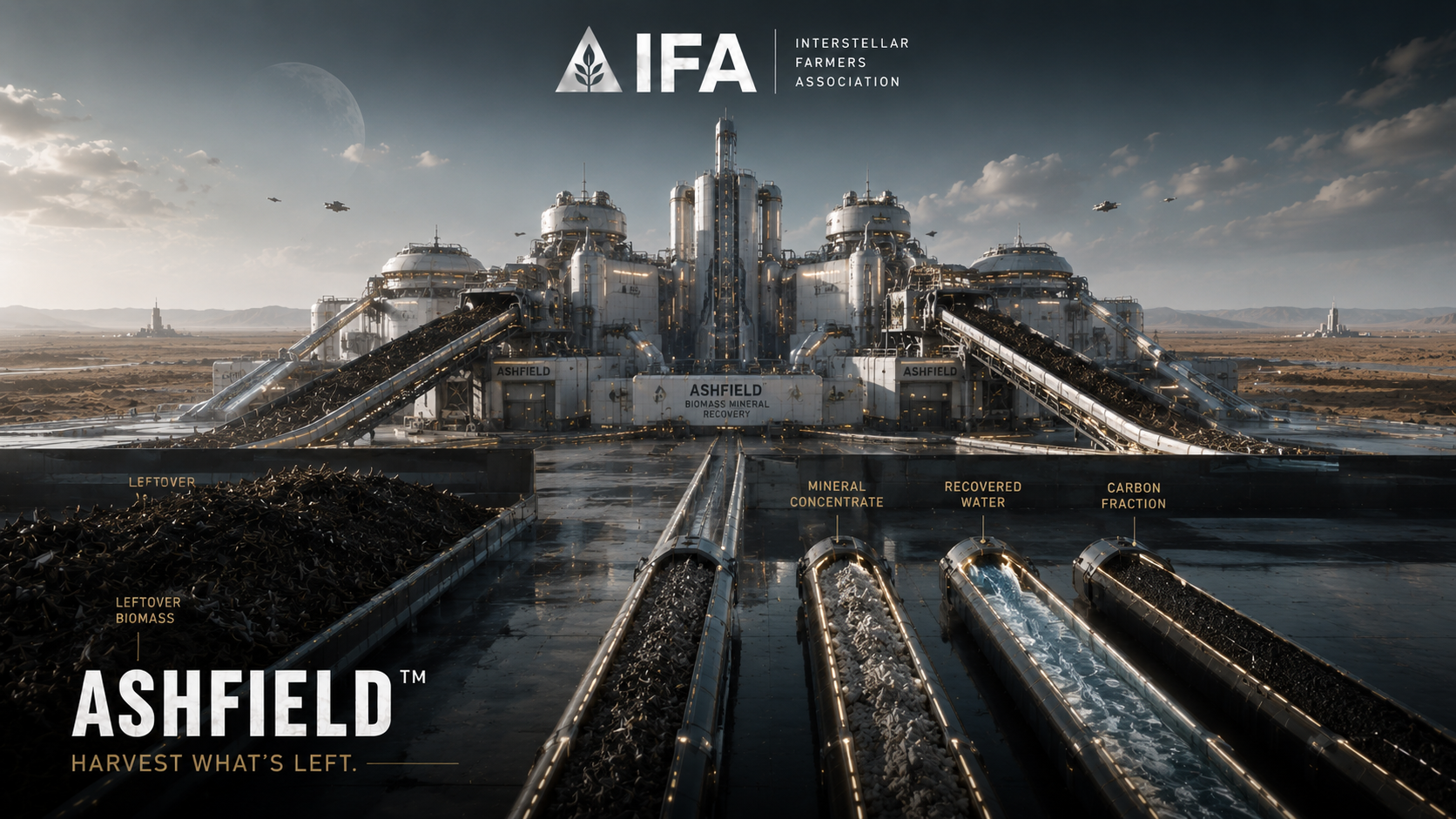
A harvested plant is not entirely product. Stalks, roots, leaves, husks, damaged crop and processing residues remain, and every fraction still contains resources: carbon, nitrogen, phosphorus, potassium, calcium, magnesium, sulphur, trace elements, water and organic compounds.
Those materials were extracted from the planet, transported through the agricultural system and assembled biologically by the crop.
Discarding that inventory after a single production cycle is inefficient. ASHFIELD™ was developed to recover it.
ASHFIELD is an industrial biomass reduction and mineral recovery system designed to extract the remaining agricultural value from biological material after its primary commercial value has been removed.
The harvest is not finished when the crop leaves the field.
It is finished when there is nothing left worth recovering.
THE SECOND HARVEST
Agriculture traditionally distinguishes between crop and residue. ASHFIELD treats that distinction as temporary. The commercially valuable fraction of a plant is harvested first.
Everything remaining becomes feedstock for a second extraction process.
Crop residues can contain substantial quantities of nutrients accumulated during growth. Roots, stalks, leaves and processing residues represent material that has already passed through the most expensive stages of the agricultural system.
The minerals inside them have already been located. Extracted. Processed. Distributed. Absorbed.
ASHFIELD prevents that investment from ending in discarded biomass.
The first harvest recovers the product.
ASHFIELD recovers what the product left behind.
BIOMASS IS CONCENTRATED PLANET
A plant is a biological separation system.
Its roots encounter an enormous volume of substrate and selectively acquire the elements required for growth.
Those elements are transported through the plant and concentrated within biological tissue.
At harvest, the resulting biomass therefore contains a chemically reorganized fraction of the agricultural environment from which it grew.
ASHFIELD exploits that fact.
Instead of treating residual plant material as inconvenient organic waste, the system treats it as a secondary resource deposit.
The original ore may have been kilometres underground. THE LITHOVORE extracted it from a geological inventory elsewhere. The agricultural system distributed it. The crop concentrated part of it. ASHFIELD receives it back.
By this stage, the resource has already travelled most of the way through IFA’s production chain.
There is no reason to abandon it now.
TOTAL BIOMASS ACCOUNTING
ASHFIELD begins with accounting.
IFA does not measure only saleable yield.
The complete biological mass produced by a cultivation cycle is quantified.
Commercial product is separated from recoverable residue. Material remaining in the field is assessed. Processing facilities report their biological waste streams.
Rejected or contaminated batches are classified according to recoverable composition.
Even root mass can represent a significant inventory under sufficiently intensive cultivation.
The result is a biomass balance for the production region. IFA knows what entered the crop. IFA knows what left as product.
ASHFIELD determines what can still be recovered from the difference.
FIELD RECOVERY
Not all agricultural residue reaches a processing facility naturally.
ASHFIELD therefore begins at the field.
Recovery trains use heavy separation and material-handling assemblies supplied by Argo Astronautics. The machinery is recognisably Argo—rugged, serviceable and indifferent to elegance—but the recovery sequence belongs to IFA, tuned around what the crop removed from the ground and what the next cultivation cycle will require.
Where recovery is economically justified, post-harvest operations collect residual above-ground biomass after the primary harvest has been removed.
The acceptable recovery fraction depends upon the cultivation programme.
Residue that has greater value as recovered feedstock is removed. Material whose field value exceeds its recovery value can remain. The distinction is economic rather than sentimental. Under intensive extraction programmes, recovery can be extensive. The field has already performed its primary function.
Anything left standing must justify occupying the resource balance.
ROOT RECOVERY
The largest hidden biological structure of many crops lies beneath the surface.
Roots contain carbon, minerals and nutrients acquired during cultivation.
Under conventional agriculture, much of that material remains in the soil after harvest.
ASHFIELD does not automatically assume that those roots should remain.
Where the production system is approaching substrate reconstruction, terminal cultivation, or another major Agriform™ intervention, IFA can recover a substantially larger fraction of below-ground biomass.
Root recovery is therefore conditional. In a field intended for immediate reseeding, the material may be worth more where it lies. In a region approaching intensive reconstruction, the same roots may represent a recoverable inventory that would otherwise be lost during the work. ASHFIELD's decision follows what IFA intends to do with the soil next.
REDUCTION
Collected biomass enters an ASHFIELD recovery installation, where its former biological structure ceases to matter.
The system reduces heterogeneous agricultural residues into controlled material streams suitable for further separation.
Water and useful volatile fractions are separated first where the feedstock permits it. The remaining organic material can then be reduced thermally, chemically or biologically according to its composition and the resources selected for recovery.
The process is one of concentration rather than disposal. Large volumes of heterogeneous, low-value biomass enter; smaller and increasingly useful material streams emerge. What remains after each stage carries less recoverable value until only a controlled residual fraction is left.
MINERAL FRACTION
Once the organic bulk has been removed or converted, a mineral fraction remains containing the phosphorus, potassium, calcium, magnesium, sulphur, iron and trace elements accumulated by the crop during growth.
The exact composition varies according to crop, substrate, fertiliser programme and the part of the plant being processed.
ASHFIELD analyses the resulting mineral fraction and separates it according to potential reuse.
Recoverable agricultural nutrients can return to the local inventory for later production cycles, while useful industrial elements enter the processing streams appropriate to them. Material exits the recovery chain only when analysis can no longer identify sufficient value in retaining it.
CARBON
Most dry plant biomass is not mineral. It is carbon-rich biological material. ASHFIELD therefore has to decide what that carbon is worth.
Depending upon local infrastructure and agricultural requirements, carbonaceous fractions can be converted into useful chemical feedstocks, retained as stabilized carbon-rich material, used within industrial processes, or further reduced to recover associated resources.
There is no universal requirement that carbon return to the field from which it came; its destination is determined by its next useful role.
Where the substrate requires organic carbon, returning an appropriate fraction may improve the next crop. Where another process provides greater value, the material moves there instead. ASHFIELD closes no cycle merely for the appearance of completeness.
WATER RECOVERY
Fresh biological material contains water, and across a planetary harvest that moisture represents a considerable mass already lifted, distributed and absorbed once.
ASHFIELD recovery installations therefore separate usable water from suitable biomass streams during processing.
Recovered water can be conditioned and returned to the agricultural supply network where economically practical.
As with minerals, water remains an asset until recovery costs more than replacement.
On DEEPWELL-dependent worlds, every recoverable unit returned from biomass is one that does not immediately have to be pumped from greater depth. The calculation is practical: recovery is worthwhile while it reduces the burden placed upon the next extraction cycle.
CONTAMINATED BIOMASS
Not every failed crop is worthless. Disease, physical damage or failure to meet commercial quality standards may remove its intended market without removing the elements held inside it. ASHFIELD provides that material with another destination.
Material unsuitable for food or other biological products can be diverted from the commercial stream and evaluated for resource recovery.
Processing conditions can be selected according to the contamination involved.
The original product may be lost. Its constituent resources need not be. A failed harvest therefore has two values: the value of the intended product, and the residual value of its matter. ASHFIELD exists for the second.
THE LITHOVORE AND ASHFIELD
THE LITHOVORE and ASHFIELD operate at opposite ends of the same material flow. The Lithovore imports geological feedstock into agriculture; ASHFIELD intercepts what remains recoverable after biological production. Neither eliminates the need for the other because recovery is never complete.
Commercial agricultural products leave the system carrying material with them.
Some resources become uneconomical to separate. Some remain distributed through the cultivation environment. Losses occur. ASHFIELD reduces the rate at which those losses must be replaced. THE LITHOVORE supplies the remainder.
Together, the systems allow IFA to determine how much fresh planetary material must enter each production cycle. Perfect closure is unnecessary; the useful objective is to avoid mining the same tonne twice when recovering it from the previous harvest is cheaper.
TERMINAL RECOVERY
ASHFIELD becomes most aggressive when an agricultural region approaches the end of its current production cycle.
If IFA intends to reconstruct the substrate, initiate major Agriform™ intervention or abandon the existing cultivation system entirely, the value of leaving biological resources in place changes.
Standing residue, root systems, stored organic waste, sediments and other concentrated agricultural deposits can all be evaluated before the region is reset.
Material that would ordinarily contribute to future soil development has little reason to remain if that future is no longer part of the current operating plan.
The final harvest can therefore extend far beyond the commercial crop. ASHFIELD recovers the biological capital still embedded in the production system before the system itself is reset.
EXTRACTION BEFORE RECONSTRUCTION
Agriform™ gives IFA an option unavailable to agriculture dependent upon slow natural recovery.
A degraded agricultural environment does not necessarily have to be nursed gradually back toward productivity; it can be reconstructed. That option changes the value of every biological resource still embedded in the old system.
If a production region is scheduled for substantial environmental intervention, preserving every existing soil process may offer less value than recovering useful material before reconstruction begins.
ASHFIELD can therefore precede Agriform™, recovering what remains before environmental reconstruction begins.
The existence of reconstruction technology allows resource recovery to proceed further than would be acceptable in an agricultural system dependent upon preserving the existing field indefinitely.
NOTHING LEAVES UNMEASURED
The defining principle of ASHFIELD is not recycling but accounting.
Every tonne entering planetary agriculture represents extracted resources, processing, transport and energy.
Every tonne leaving as commercial product has an assigned purpose; everything left behind is examined for another one. Phosphorus, water and carbon may each take a different route according to the next production requirement. Material returns to the field when that offers the greatest yield, enters another process when it has greater value there, and becomes waste only when no economically useful function remains.
IFA does not require matter to circulate forever. It requires a reason before allowing it to leave the system.
SCIENCE & TECHNOLOGY
ASHFIELD originated within IFA Science & Technology as agricultural production moved toward increasingly aggressive nutrient extraction.
Its first response to rising nutrient demand had been to increase supply. The next was to examine where that supply went after harvest.
A significant fraction remained distributed through biological material that conventional agricultural accounting treated as residue.
ASHFIELD combined biomass handling, thermal and chemical conversion, mineral separation, water recovery and agricultural resource accounting into a single post-harvest system.
The result extends the productive chain beyond the commercial crop. Agriculture draws material from the planet and assembles it into life; ASHFIELD returns after the harvest to determine how much of that investment can serve again.
ASHFIELD™
A field after harvest still contains another harvest, distributed through stalks, roots, rejected crop, processing residue, water and minerals already extracted once. ASHFIELD gathers that remainder, reduces it and separates what can still serve the production system. Only then is what remains permitted to stay behind.