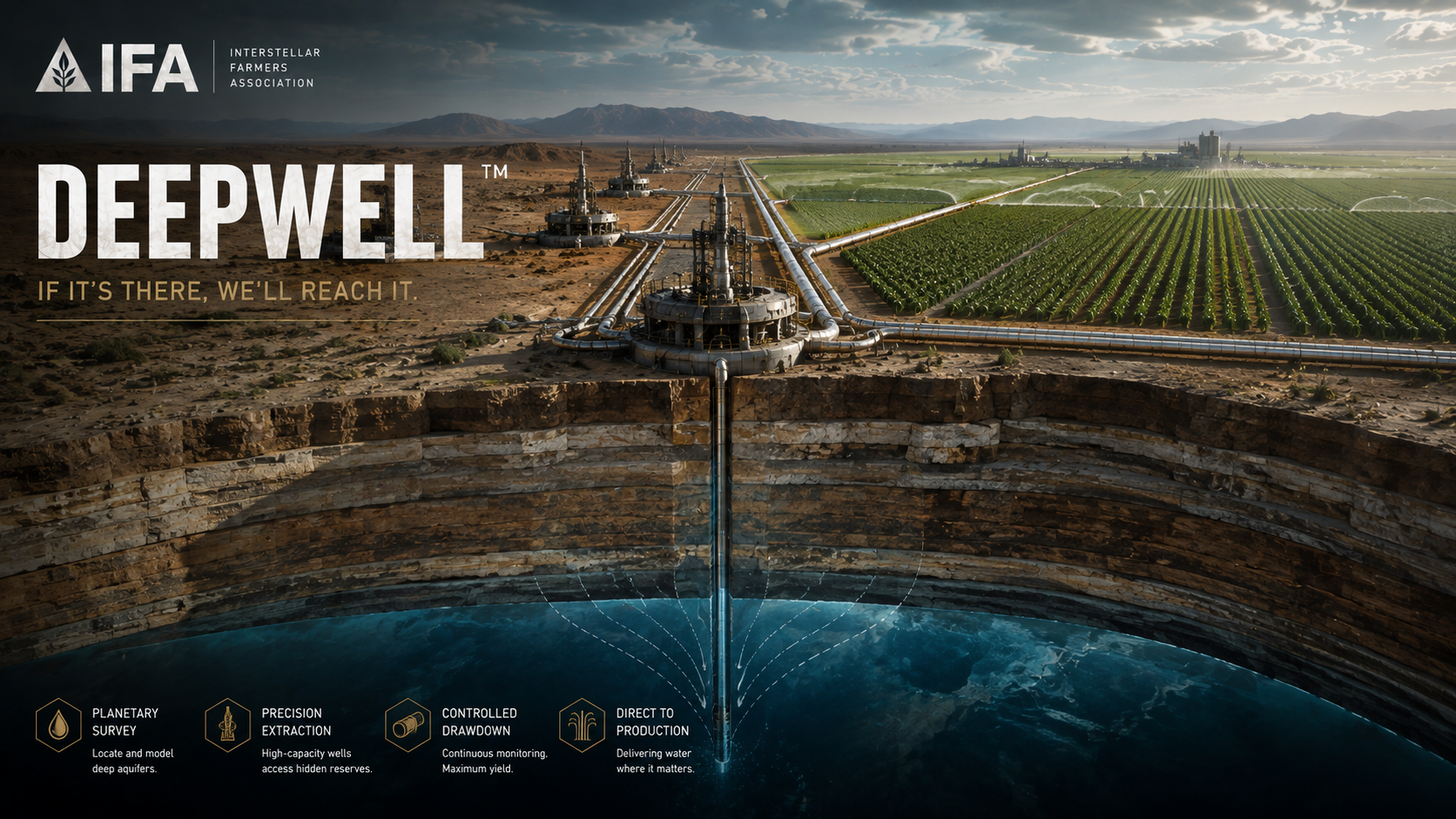
Water beneath a planet’s surface has no agricultural value until it reaches the crop.
An aquifer may contain enough water to support centuries of natural hydrological activity and still contribute nothing to agricultural production. Depth, pressure, geology, salinity and distance separate the resource from the field.
DEEPWELL™ removes that separation. It is a planetary-scale prospecting, extraction and distribution system that converts subsurface reserves into controlled agricultural supply, going directly to the water rather than waiting for it to enter the surface cycle.
WATER AS A PLANETARY RESERVE
Conventional agriculture generally begins with available water. Rivers. Lakes. Rainfall. Shallow groundwater. DEEPWELL begins with total accessible inventory.
IFA surveys the subsurface to identify water-bearing geological formations regardless of whether those reserves participate significantly in the existing surface hydrological cycle.
Deep confined aquifers, porous sedimentary formations, fractured rock reservoirs and buried water-bearing strata can all represent agricultural resources if extraction is technically and economically viable.
The question is therefore not: How much water reaches this region naturally? It is: How much water exists beneath it? Those are very different numbers.
PLANETARY HYDROLOGICAL PROSPECTING
DEEPWELL begins with mapping.
Orbital remote sensing, geological surveys, geophysical measurements and exploratory drilling are combined into a three-dimensional model of the planetary subsurface.
The first model is rarely built from nothing. IFA licenses historical bore records and geological surveys from Shubin Interstellar, then commissions Greycat Industrial equipment for exploratory and production wells. The suppliers provide maps and machinery; DEEPWELL™ decides how long the reserve remains worth pursuing.
IFA is not simply searching for the presence of water. The survey must establish where a reserve lies, how it behaves and whether it can support the intended agricultural system.
- Location
- Depth
- Volume
- Pressure
- Geological confinement
- Expected recharge
- Connectivity between reserves
- Salinity
- Temperature
- Extraction accessibility
A dry landscape may conceal an exceptional agricultural reserve.
DEEPWELL is designed to find it.
THE EXTRACTION FIELD
Large aquifers are not exploited through a single well.
DEEPWELL establishes distributed extraction fields across the productive reservoir.
Individual bore installations penetrate the target formation and feed a common collection network. Extraction is distributed according to local permeability, reservoir geometry, pressure and agricultural demand.
The field functions as one hydraulic machine.
Where one section of the aquifer can sustain greater withdrawal, extraction increases.
Where local drawdown begins to reduce efficiency, load can be redistributed across the network.
As agricultural territory expands, additional extraction nodes can be brought online.
The visible wellhead is therefore only the smallest component of DEEPWELL.
The actual machine is the aquifer.
CONTROLLED DRAWDOWN
Pumping changes the reservoir.
DEEPWELL is designed around that fact.
As groundwater is removed, hydraulic pressure changes and local water levels decline. Extraction from one location can influence neighbouring parts of a connected aquifer.
IFA models these effects continuously. The objective is not to prevent drawdown. The objective is to control it.
A declining reservoir remains productive while sufficient water can be recovered at an acceptable energy and infrastructure cost.
DEEPWELL therefore calculates extraction against remaining reserve, pumping depth, hydraulic response and projected agricultural demand.
A falling water table is not, by itself, a system failure.
It is the expected movement of inventory from below ground into production.
DEPTH IS AN ENGINEERING COST
As the reservoir declines, water may become more expensive to recover.
Pumping distance increases. Pressure conditions change. Additional wells may be required. Energy demand rises. DEEPWELL incorporates those changes into the operating model.
The system does not assume that every unit of groundwater has equal value.
Early extraction from accessible high-yield sections may be considerably cheaper than recovering the final fraction of a depleted formation.
IFA therefore models the aquifer as a graded reserve.
Extraction continues while the agricultural value supported by the remaining water justifies the cost of recovering it.
The physical bottom of the aquifer is not necessarily the operational limit.
Economics may reach it first.
FROM WELLHEAD TO FIELD
Extraction alone does not irrigate a planet.
DEEPWELL connects its well fields to a high-capacity distribution network capable of moving groundwater from geological reserves to agricultural production zones.
Water recovered across the extraction field is consolidated into trunk systems before being distributed toward regional agricultural networks.
This allows the location of the aquifer and the location of the crop to be partially separated.
Agriculture no longer needs to sit directly above the most productive well.
A major subsurface reservoir can support cultivation across a much larger surrounding territory if sufficient distribution capacity exists.
DEEPWELL therefore depends equally upon vertical extraction and horizontal distribution. The first reaches the reserve; the second carries it to the agricultural territory where it becomes useful.
WATER CONDITIONING
Subsurface water is not automatically suitable for crops.
Dissolved salts, metals, extreme mineral concentrations or other chemical characteristics can make untreated groundwater unsuitable for direct agricultural application.
DEEPWELL therefore evaluates extracted water before it enters the agricultural network.
Where conditioning is required, treatment installations remove or adjust constituents incompatible with the intended crop and substrate.
The objective is not to produce drinking water. It is to produce agricultural water. Treatment standards are determined by biological requirement.
Nothing more is processed than necessary to maintain the intended production system.
At planetary scale, unnecessary purification is simply unnecessary cost.
RECHARGE IS PART OF THE CALCULATION
Aquifers do not all obey the same clock. Some replenish continuously, some only slowly, while others are isolated reserves left behind by geological or climatic conditions that no longer exist. DEEPWELL measures that difference because recharge changes the useful life of an extraction field.
Where natural replenishment contributes materially to supply, it becomes part of the operating model. Where agricultural withdrawal overwhelms it, the reservoir is treated as a finite inventory. IFA's concern is whether that inventory can sustain the intended production programme, and for how long.
FOSSIL WATER
The most valuable DEEPWELL targets can exist beneath landscapes where substantial surface water has not been present for geological periods.
Ancient groundwater may remain trapped within deep formations long after the environmental conditions that produced it have disappeared.
DEEPWELL can turn a region that appears hydrologically barren at the surface into a major production zone by exploiting water accumulated under an entirely different planetary climate.
The age of that water matters far less than its accessibility. A landscape need not possess an active water cycle capable of sustaining industrial agriculture if a recoverable reserve lies beneath it. Once that distinction is understood, an apparently barren region can acquire the agricultural value of an entirely different world.
HIGH-DEMAND AGRICULTURE
As biological production intensifies, its demand for water rises with it. IFA does not intend to restrain productive genetics merely because local rainfall cannot sustain them. Where the subsurface inventory is sufficient, DEEPWELL allows extraction fields and distribution networks to expand with cultivation.
The practical limit is no longer the rate at which the environment happens to deliver water to the surface. It is the rate at which IFA can recover and distribute what the planet already holds at a cost the harvest can justify.
RESERVOIR DEPLETION
Every finite reservoir has an endpoint. DEEPWELL is designed to make its approach predictable.
Continuous monitoring allows remaining groundwater inventory, extraction performance and projected agricultural demand to be compared throughout the productive life of the reservoir.
This allows IFA to determine when additional wells are justified, when deeper recovery becomes economical, when neighbouring reserves should be integrated and when continued extraction no longer supports the required production.
The objective is to obtain the greatest useful production from the available reserve while seeing the end early enough to prepare for it. As recovery becomes uneconomical, mobile plant and operating capacity can move to the next field, fixed wells can be retired, and the agricultural network can be reconfigured around another source.
Dependence does not make water permanent. DEEPWELL gives IFA the time and information required to decide what follows when a reservoir has completed its service.
AFTER AGRIFORM
Agriform™ can establish environmental conditions compatible with agriculture, but a favourable atmosphere and workable surface do not guarantee that precipitation or local hydrology can support cultivation at the scale IFA intends.
A successfully Agriform-engineered region can be supplied from water reserves that have little relationship to its contemporary surface climate.
By connecting such a region to reserves formed under another climate—or simply located elsewhere beneath the surface—DEEPWELL allows agricultural expansion to advance without waiting for a natural water cycle to mature around it. Agriform™ prepares the environment; DEEPWELL brings the water that makes it productive.
WATER FOLLOWS PRODUCTION
Traditional agriculture develops around water. DEEPWELL reverses the relationship.
Once a sufficiently valuable groundwater reserve has been identified, extraction and distribution infrastructure allow water to be routed toward the agricultural territory where it produces the greatest return.
Fields can expand according to production planning rather than proximity to rivers or seasonal rainfall, and regional allocation can change as crop demand changes. Hydrology ceases to be a fixed boundary on the map and becomes part of the infrastructure drawn across it.
SCIENCE & TECHNOLOGY
DEEPWELL originated within IFA Science & Technology from a simple contradiction: a world may contain enormous quantities of water while presenting almost none of it where agriculture requires it. Hydrogeology, geophysical prospecting, deep drilling, reservoir modelling, pumping and distribution were therefore brought together as one planetary resource system.
The programme creates no water of its own. It crosses the depth, pressure, chemistry and distance that keep existing reserves apart from production, turning what once appeared to be scarcity into a question of accessible inventory.
DEEPWELL™
Beneath dry ground can lie oceans that never see daylight. DEEPWELL has no requirement that they do. Once the reserve has been mapped and reached, controlled pressure carries its water into a surface network and onward to fields that could never have existed under the planet’s natural hydrology.
Far below, the reserve begins its measured decline. Across the surface, the harvest begins to rise.