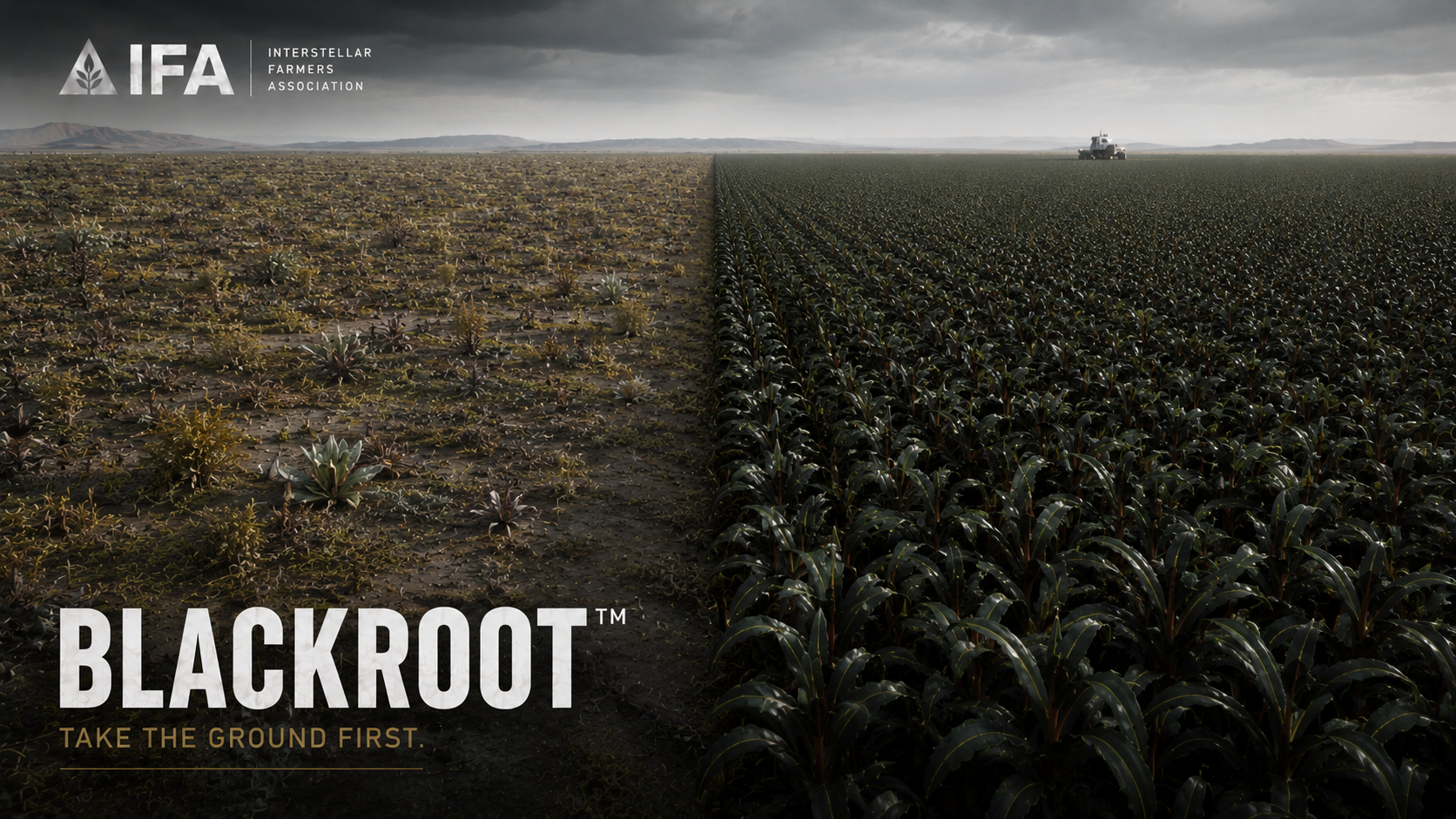
Agricultural land does not need to be empty before cultivation begins. It needs to belong to the crop.
Newly opened agricultural territory may contain native vegetation, opportunistic colonisers, incompatible microbial communities or persistent biological competition. Recently Agriform-engineered terrain presents another problem: the physical environment may have become suitable for agriculture before a productive agricultural ecology has established itself.
Conventional development treats these conditions as separate problems of clearance, soil preparation and biological establishment.
BLACKROOT™ treats them as a succession problem.
IFA Biolabs leads the programme with contracted strain analysis from Rayari Inc., a company known across the Empire for agricultural bioengineering and plants designed to survive altered worlds. Rayari characterises candidate ecologies; IFA decides which organisms are permitted to remain once BLACKROOT™ has passed.
BLACKROOT is a family of engineered pioneer crops designed to occupy agricultural territory before commercial cultivation begins.
They spread quickly, establish aggressively, suppress competition and alter the substrate. Then they are removed. BLACKROOT is not itself the harvest; it prepares the world for one.
FIRST OCCUPATION
The first crop planted on new agricultural territory faces conditions later crops do not.
The substrate may be physically poor, organic material limited and nutrients unevenly distributed.
Existing vegetation may compete for water, light and mineral resources.
Microbial communities may not support the intended crop.
Open terrain may also remain vulnerable to erosion before dense agricultural cover has been established.
BLACKROOT is designed specifically for this transitional environment.
Rather than immediately committing high-value commercial genetics to imperfect terrain, IFA first deploys an organism whose only meaningful product is control of the cultivation zone.
BLACKROOT occupies the ground.
Commercial agriculture follows.
COMPETITIVE EXCLUSION
Plants compete. For light. For water. For nutrients. For physical space. For access to the root zone.
BLACKROOT weaponises that competition for agricultural site preparation.
Its growth characteristics are selected to establish dense coverage rapidly and deny resources to unwanted vegetation.
Fast canopy formation reduces available light beneath the crop.
Dense root occupation competes for water and nutrients.
Rapid establishment reduces open niches available to later colonisers.
The objective is not necessarily to destroy every other organism within the cultivation zone.
That would often require unnecessary effort.
The objective is to make their continued presence agriculturally irrelevant.
BLACKROOT does not need an empty field.
It needs dominance.
A CROP WITHOUT A MARKET
Commercial crops are normally judged by the value of what can be harvested from them.
BLACKROOT is judged differently.
Its performance metrics include:
- Establishment speed
- Surface coverage
- Root penetration
- Competitive suppression
- Biomass accumulation
- Substrate modification
- Termination reliability
A BLACKROOT strain can therefore be exceptionally successful while producing nothing worth selling.
That is intentional.
Every biological characteristic is available for optimisation because taste, appearance, nutritional quality and conventional market yield are irrelevant.
The plant has one customer.
The next crop.
ROOT OCCUPATION
The most important part of BLACKROOT may never be visible.
Below the surface, aggressive root systems expand through the available substrate and occupy the volume that will later support commercial agriculture.
Root architecture can be selected according to local conditions. Compacted upper layers may favour dense penetrating systems. Dry environments may require rapid vertical exploration.
Poorly structured substrate may benefit from extensive branching capable of exploiting fractures and increasing biological penetration.
The purpose is not merely nutrient acquisition for BLACKROOT itself.
Roots physically and chemically interact with the substrate. They create channels. They redistribute biological material. They alter local chemistry.
They establish interfaces between mineral substrate and living systems.
When BLACKROOT is terminated, the architecture it created does not immediately disappear.
The first crop leaves infrastructure for the second.
BIOLOGICAL PRESSURE
Not all competition occurs between visible plants.
The root zone contains fungi, bacteria and other organisms capable of influencing crop establishment.
Some are useful. Some are irrelevant. Some are incompatible with the intended agricultural system.
Where the next crop requires a particular below-ground biological community, selected microbial inoculants can be introduced while the pioneer crop occupies the surface.
The crop and inoculants operate together.
BLACKROOT provides biological mass, root habitat and continuous occupation of the cultivation zone.
The introduced organisms begin establishing the microbial environment required for subsequent agriculture.
Instead of waiting for a desirable soil ecology to develop spontaneously, IFA introduces one during site occupation.
By the time the pioneer crop is removed, the field has already begun operating according to a different biological regime.
SUBSTRATE CONDITIONING
A newly viable substrate is not necessarily a productive agricultural substrate.
BLACKROOT accelerates the transition. Plant growth introduces organic compounds into the root zone. Roots alter physical structure. Dead root material contributes biological matter. Surface biomass modifies exposure conditions.
Nutrient distribution changes as the plant acquires material from one part of the substrate and redistributes it through its tissues.
Different BLACKROOT strains can therefore be selected according to the deficiencies of the target site.
The programme does not attempt to reproduce centuries of natural soil formation. It identifies the characteristics required by the next production cycle and accelerates their development, leaving everything without an immediate agricultural function outside the brief.
RESOURCE AGGRESSION
A pioneer crop intended to dominate difficult territory cannot behave cautiously.
BLACKROOT strains are selected for aggressive acquisition of available resources. Their roots take the water and nutrients they encounter, their canopy converts available light into biomass, and their growth closes open ground before competing vegetation can establish itself.
Such behaviour would be undesirable in a crop expected to coexist indefinitely with a diverse plant community. BLACKROOT has a shorter and more exacting purpose: it must win the initial competition quickly enough for IFA to replace it with a more valuable organism. Its efficiency is measured in time to agricultural control.
ENGINEERED SUCCESSION
Natural ecosystems change through succession as pioneer organisms occupy disturbed ground, alter it and make way for the species that follow. BLACKROOT compresses that process into an engineered agricultural sequence. IFA begins with the field it intends to operate and selects the pioneer backward from that requirement.
If the intended commercial crop requires deeper rootable substrate, BLACKROOT prepares for depth.
If it requires a particular rhizosphere, BLACKROOT carries or supports the necessary biological inoculation.
If competing vegetation represents the primary obstacle, exclusion becomes dominant.
BLACKROOT is therefore not a universal plant but a programmable stage in agricultural succession. The field that follows determines the pioneer that precedes it.
AFTER AGRIFORM
BLACKROOT occupies an important position in the Agriform™ sequence. Agriform can move regional conditions toward biological viability, but an environment capable of supporting crops is not necessarily ready for industrial cultivation. BLACKROOT occupies the interval between those two states.
Once environmental conditions cross the required biological threshold, pioneer deployment can begin.
Large areas can be seeded before they are suitable for high-value production, allowing biological occupation to advance while irrigation, logistics and cultivation infrastructure are completed. By the time the commercial system arrives, it encounters land already prepared for it rather than untouched terrain.
THE BLACKROOT FRONT
On very large projects, BLACKROOT cultivation does not need to occur everywhere simultaneously.
It can advance as a moving agricultural frontier, with newly viable or newly acquired terrain ahead and commercial production behind. BLACKROOT occupies the intervening band, moving outward as environmental conditions, irrigation, nutrient supply and logistics permit.
This creates a deliberate sequence in which environmental viability is followed by pioneer occupation, controlled termination and finally commercial cultivation. Figure 01 shows that progression as a single managed transition.
The pioneer field is temporary by design. At planetary scale it becomes less a fixed crop than a moving front of biological conversion.
TERMINATION
An aggressive pioneer organism is useful only if IFA can stop it, making termination as important to BLACKROOT as establishment.
The system cannot depend upon the pioneer voluntarily losing competition against the commercial crop intended to replace it.
IFA determines when occupation ends, rather than asking the commercial crop to overcome the pioneer unaided.
Different BLACKROOT strains can employ controlled reproductive characteristics, limited generational persistence or engineered susceptibility to specific termination protocols.
The precise mechanism may vary between strains, but the operating requirement remains constant: once the field has performed its function, BLACKROOT must be removable at industrial scale.
The transition should be rapid enough that the cultivation zone moves from site preparation to revenue production with minimal idle time.
A pioneer crop that cannot be reliably removed has failed regardless of how effectively it grows.
CONTAINMENT
The strength required to dominate a cultivation zone creates an equally obvious risk beyond it. Conventional field boundaries are insufficient, so reproductive control, deployment planning and termination systems belong to the technology rather than to its operational aftermath.
Within its deployment window the strain can remain extremely competitive because persistence outside that window is engineered separately. Aggression delivers the performance; containment keeps that performance under IFA control.
SECONDARY BIOMASS
At termination, BLACKROOT may leave enormous quantities of biological material, and its destination depends upon what the next crop requires.
A fraction may remain where its contribution to substrate conditioning has greater value than recovery.
A fraction may be mechanically incorporated into the cultivation layer.
And where recoverable minerals, water or carbon justify extraction, biomass can be diverted into ASHFIELD™.
BLACKROOT does not automatically enrich the soil by sacrificing itself. IFA decides whether the dead pioneer is worth more inside the field, incorporated into the cultivation layer, or outside it as ASHFIELD™ feedstock. The next production cycle receives whichever choice offers the greater agricultural value.
DISPLACEMENT INSTEAD OF CLEARANCE
BLACKROOT changes the economics of biological site preparation because it does more than clear the land. Mechanical removal can eliminate existing vegetation without establishing what must replace it; chemical suppression can leave the ground biologically vacant. BLACKROOT occupies and prepares the cultivation zone at the same time.
As competing organisms lose access to light, water and nutrients, the pioneer takes possession and begins altering the substrate beneath it. A preferred root-zone ecology can establish during the same interval. When IFA replaces BLACKROOT with commercial genetics, the land passes directly from one managed biological state into another.
There is no requirement for an intermediate period in which the land remains biologically idle.
SCIENCE & TECHNOLOGY
BLACKROOT originated within IFA Science & Technology from a recurring limitation in large-scale agricultural expansion: environmental engineering could make territory viable faster than conventional biological processes could make it useful.
IFA combined crop genetics, root architecture, competitive ecology, soil science and controlled biological succession into a temporary agricultural organism designed specifically for the period between environmental viability and commercial cultivation.
The programme does not attempt to imitate a mature ecosystem. It asks which biological conditions the next crop requires, then constructs the shortest controlled succession capable of producing them.
BLACKROOT™
Before the first commercial crop enters the field, BLACKROOT spreads through it, drives its roots into the substrate and denies the existing biological landscape the resources it once possessed. Beneath the surface, the conditions required by the next crop begin to assemble.
Then the order changes. The pioneer is terminated and the production crop arrives on ground that has already undergone its first cultivation. What appears to be the beginning of agriculture is, in fact, its second planting.